
General Motors DUKW
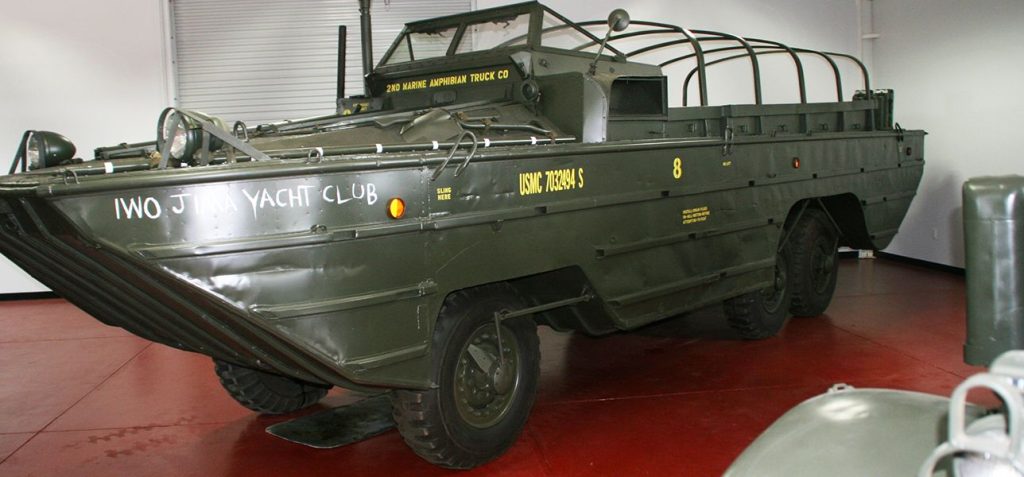
Specifications
| Crew | 2+25 | ||
| Manufacturer: | General Motors Corporation | ||
| Engine: | 270 cubic inch GMC straight 6 | ||
| Length: | 31 feet | ||
| Width: | 8 feet 4 inch | ||
| Height: | 8 feet 8 inch with top up | ||
| Weight: | 7.5 tons | ||
| Water Speed: | 6.4 mph | ||
| Road Speed: | 50 mph | ||
| Number Manufactured: | 12,000 | ||
| Capacity Troops: | 25 or 12 on litters | ||
| Capacity Cargo: | 5 tons | ||
| Status | Active Display (drivable) | ||
| Owner: | Estrella Warbird Museum |
History
The DUKW was developed quickly during World War II to meet the need for amphibious cargo transfer from ship to shore. The nomenclature DUKW was assigned by the manufacturer, General Motors Corporation, from:
- D= First year of Manufacture (1942)
- U= Utility vehicle (amphibious)
- K= All Wheel Drive
- W= Rear tandem axle.
Someone quickly noticed that DUKW could be pronounced “duck” and the “Amy Duck” was born. The first operational use of the DUKW was in March 1943 when the U.S. landed troops on Noumea, New Caledonia. Later organized into companies, the DUKW displayed its versatility by carrying ammunition directly from anchored ships to shore. This use of DUKWs kept casualties to a minimum, but a bigger purpose surfaced as American ingenuity took over. Some of the DUKWs were modified to carry 4.5 inch rockets.
General Patton and General Eisenhower realized the DUKW was an invaluable war tool, and they were impressed by its capabilities. Over 1,000 DUKWs were used in the Sicilian landings of 1943 alone. Operation Overlord, the landing in Normandy, was the most crucial operation in history with circumstances that made the DUKWs virtually indispensable. Approximately, 2,000 DUKWs brought to shore 40% of all supplies landed between June 6 and September 1, 1944.
Colonel Frank Speir, Project Engineer of the Army´s Amphibious Warfare Program until the time of his death on 8 July 1956, one of the fathers of the US Army’s DUKW, thought that foils could increase the sea speed of this vehicle. He initiated a contract with Lycoming Division of AVCO and Miami Shipbuilding Corp to build a prototype. Adapting data from HALOBATES, including its autopilot, and using a Lycoming T-53 gas turbine for main propulsion, a flying DUKW was designed, and successful demonstration trials were conducted in Miami waters. Speeds in excess of 30 kt were demonstrated (compared with the 5 kt of the conventional DUKW).