US-2D
Specifications
| Manufacturer: | Grumman | |
|---|---|---|
| Year/Model: | 1953 US-2D Stoof | |
| S/N: | ||
| Tail Number: | ||
| Power Plant: | Two 1,525 hp Wright R- 1820’s | |
| Wingspan: | 69 feet 8 inches | |
| Length: | 42 feet 3 inches | |
| Height: | 16 feet 3 inches | |
| Gross Weight: | 26,300 pounds (Empty weight: 17,357 pounds) | |
| Maximum Speed: | 287 mph | |
| Maximum Range: | 841 statute miles | |
| Service Ceiling: | 22,800 feet | |
| Crew: | 2+ | |
| Status: | Static Display | |
| Owner: | Estrella Warbirds Museum | |
In Flight
History
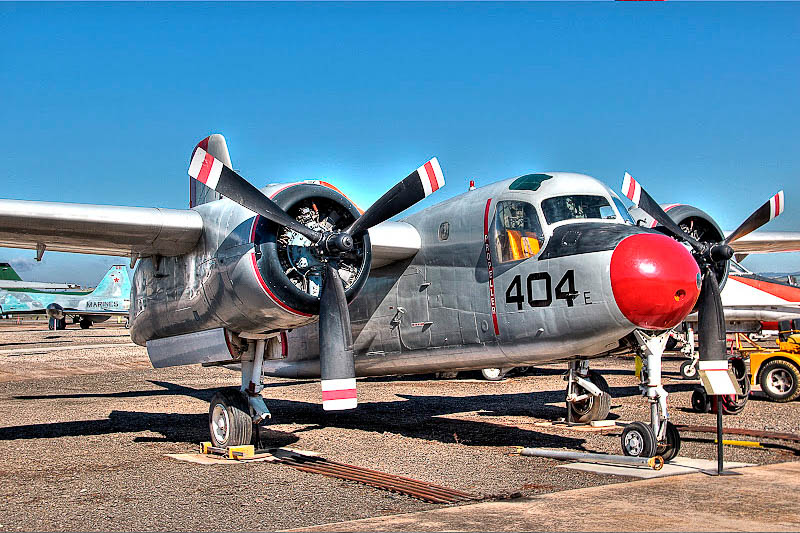
Originally designated S2F (and Tracker when it carried a huge, teardrop shaped radome on top), and affectionately known as “Stoof,” this one was converted to a utility aircraft, hence the designation “US.” Designed to operate from carriers as a ship-to-shore transport. The “Firecat” designation was used for plane utilized to fight fires.
The Grumman S-2 Tracker (previously S2F) was the first purpose-built, single airframe anti-submarine warfare (ASW) aircraft to enter service with the US Navy. In the late 1940s, the US Navy finalized its ideas on a carrier-based submarine hunter/killer aircraft. The Grumman S2F was designed to meet this role and first flew in 1952. The S2F was re designated as the S-2 in 1962 and not phased out until replaced by the Lockheed S-3 Viking in the mid-1970s.
Variants of the Tracker were also used as transports (the C-1 Trader) and Airborne Early Warning aircraft (the E-1 Tracer). Trackers served in the armed forces of Australia, Canada and Israel. After being phased out of military service, several Trackers have been converted to firefighting aircraft named the Firecat.
Anti-Submarine Warfare (ASW) S2F Trackers carried 16 sonobuoys which were dropped to the water’s surface. The sonobuoys, each transmitting via aquaphone, listened beneath the surface to triangulate a sub’s position. A radome, Magnetic Anomaly Detector (MAD) boom, Signal-Underwater- Sound (SUS) devices and a powerful searchlight completed its sensing package. Torpedoes, depth charges and rockets were used for offensive measures, including its biggest “stick”, a nuclear depth charge. Hard points under the wings could carry rockets or could ferry torpedoes.