
L-2
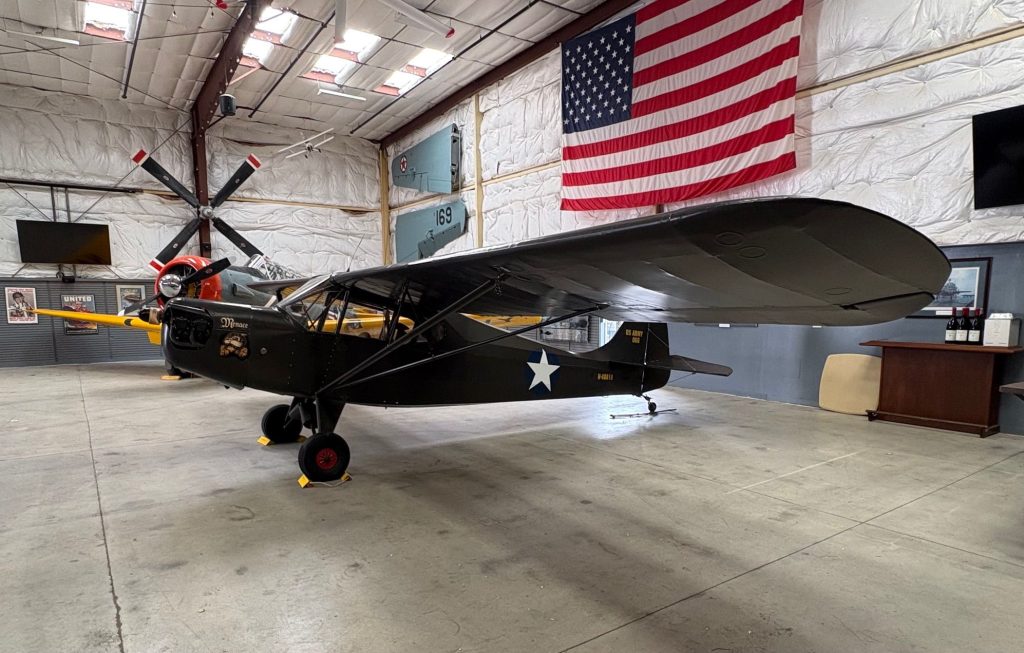
Specifications
| Manufacturer: | Taylorcraft | |
|---|---|---|
| Year/Model: | 1941 | |
| S/N: | 066 | |
| Tail Number: | N-48818 | |
| Power Plant: | Continental O-170-3 | |
| Wingspan: | 35 feet 2 inches | |
| Length: | 22 feet 9 inches | |
| Height: | 6 feet 8 inches | |
| Gross Weight: | 1,300 pounds | |
| Maximum Speed: | 102 mph | |
| Cruising Speed: | 92 mph | |
| Service Ceiling: | 16,000 feet | |
| Range: | 230 statute miles | |
| Status: | Privately Owned/ Operational/ On Display | |
| Owner: | ||
*Aircraft listed “On Loan” are privately owned by individuals or corporations and are proudly displayed at the Estrella Warbird Museum. The Estrella WarBirds Museum does not own, restore, operate nor maintain flyable aircraft. We are grateful that the owners display their aircraft at the museum for the public to view. Any courtesy rides given by aircraft owners is an agreement solely between the person that owns the aircraft and passenger.
History
The Taylorcraft L-2 “Grasshopper” was a light observation and liaison aircraft developed in the United States during the early years of World War II. It originated from the prewar Taylorcraft Model D, a civilian two-seat trainer that proved adaptable for military use due to its simplicity, reliability, and short takeoff and landing capability.
In 1941, the U.S. Army Air Forces ordered several Model D aircraft for evaluation under the designation YO-57. These aircraft were tested during large-scale military maneuvers in Louisiana and Texas, where they demonstrated their usefulness in roles such as courier service, light transport, and battlefield observation.
During these trials, the aircraft earned the nickname “Grasshopper,” reportedly inspired by its ability to operate from rough, short fields and its distinctive landing characteristics. Following successful evaluations, the Army placed production orders under the designation O-57. In March 1942, as part of a broader reclassification system, the aircraft was redesignated as the L-2, with the “L” standing for “liaison.”
Throughout World War II, the L-2 served primarily as a liaison and observation platform. It was used for artillery spotting, short-range reconnaissance, and communication duties between ground units. Its ability to take off and land in small, unimproved areas made it especially valuable in forward operating environments. In many ways, it fulfilled a role similar to the observation balloons used during World War I, providing commanders with real-time battlefield visibility.
Although highly capable, the L-2 was used more extensively within the United States for pilot training and support roles than in overseas combat operations. Several variants were produced during the war, incorporating changes such as improved visibility, different engines, and modifications for specialized observation duties. In total, nearly 2,000 examples of the L-2 and its variants were built.
After the war, many surplus L-2 aircraft were sold into civilian hands, where they were converted for private use and sport flying. Their rugged construction and forgiving flight characteristics helped ensure their continued operation for decades. A number of these aircraft remain airworthy today, preserved by collectors and aviation enthusiasts as examples of early military liaison aviation.